
st. louis Bedsore & Pressure Ulcer Lawyer
Strategic Advocacy for Serious Bedsore and Pressure Ulcer Cases in St. Louis
A Stage III or Stage IV bedsore is not a natural consequence of aging. It is not an unavoidable side effect of illness. In almost every case, it is the visible evidence that a nursing home, hospital, or long term care facility failed to deliver the basic care its residents were promised. A pressure ulcer that reaches muscle, tendon, or bone represents days or weeks of neglect: staff who did not reposition the resident, who did not inspect the skin, who did not manage moisture and nutrition, and who did not escalate when early warning signs appeared. When that happens, Missouri law gives families the right to hold the facility accountable.
If you or someone you love developed a serious pressure ulcer while in the care of a St. Louis area facility, you deserve straight answers and experienced representation. Call Kevin Etzkorn Law at (314) 987-0009 today for a free, confidential consultation, or contact our St. Louis office online. Kevin Etzkorn has spent more than two decades handling institutional negligence and catastrophic injury cases in Missouri courts, and there is no fee unless we recover for your family.
What Is a Pressure Ulcer or Bedsore?
A pressure ulcer, also called a pressure injury, pressure sore, decubitus ulcer, or bedsore, is an area of skin and underlying tissue that has been damaged by sustained pressure. When a person is unable to reposition themselves for long periods, the weight of the body cuts off blood flow to the skin over bony areas such as the tailbone, hips, heels, ankles, shoulder blades, and back of the head. Without adequate blood flow, the tissue dies, and an open wound forms. Left untreated, these wounds can burrow deep into the body, expose muscle and bone, and become infected with bacteria that lead to sepsis and death.
Pressure ulcers are one of the most widely recognized markers of substandard long term care. The National Pressure Injury Advisory Panel has published detailed clinical guidelines that any competent facility is expected to follow, and both federal and Missouri regulators track pressure injury rates as a core quality measure. When a resident who was admitted with intact skin later develops a Stage III, Stage IV, or unstageable pressure injury, that outcome should trigger serious scrutiny.
The NPIAP Pressure Injury Stages
Pressure injuries are formally staged using a system developed by the NPIAP. Understanding the staging matters because it shapes both medical treatment and the strength of a legal case.
- Stage 1 presents as intact skin with non-blanchable redness, typically over a bony prominence. It is a warning sign that pressure is causing damage.
- Stage 2 involves partial thickness loss of skin, appearing as a shallow open ulcer or a fluid filled blister.
- Stage 3 is full thickness tissue loss, exposing subcutaneous fat. The wound may include undermining and tunneling.
- Stage 4 is full thickness tissue loss with exposed muscle, tendon, or bone. These wounds carry a high risk of osteomyelitis, sepsis, and death.
- Unstageable injuries are covered by dead tissue or eschar that obscures the true depth.
- Deep tissue pressure injury appears as a persistent non-blanchable deep red, maroon, or purple discoloration and signals damage beneath the surface that may progress rapidly.
Stage III, Stage IV, unstageable, and deep tissue injuries are considered serious harm events by federal regulators, and in nearly every case they should have been prevented.
Why Bedsores Are Almost Always Preventable
Modern medicine has known for decades how to prevent pressure ulcers. The interventions are basic, well documented, and inexpensive. When they fail, it is almost always because a facility cut corners.
The Standard of Care in Pressure Injury Prevention
A competent facility is expected to:
- Conduct a pressure injury risk assessment on admission and at regular intervals, typically using the Braden Scale
- Reposition immobile residents at least every two hours, or more often if warranted
- Use pressure redistribution surfaces such as low air loss mattresses or foam overlays for at risk residents
- Keep skin clean and dry, promptly changing briefs and linens after incontinence
- Provide adequate nutrition and hydration, including consultations with a dietitian when needed
- Inspect the skin daily, especially over bony prominences, and document findings
- Escalate any Stage 1 redness immediately so the plan of care can be adjusted before the injury worsens
- Involve a wound care specialist when appropriate
When staff follow these steps, serious pressure injuries are rare. When staff fail to follow them, serious pressure injuries are foreseeable, and that is the legal definition of negligence.
Root Causes of Preventable Bedsores in St. Louis Facilities
The failures we see repeatedly in St. Louis pressure ulcer cases include chronic understaffing, inadequate training of certified nurse aides, failure to reposition residents on schedule, poor incontinence care, failure to communicate skin changes to nurses and physicians, and corporate policies that prioritize census and profit over resident safety. These are institutional failures, not individual accidents, and they support the kind of institutional negligence claim that Kevin Etzkorn Law is built to handle. For a broader look at how we approach these matters, review our St. Louis nursing home lawyer page.
When Bedsores Signal Nursing Home or Hospital Negligence in St. Louis
Not every pressure sore is the result of negligence. A resident admitted with an existing wound, or one facing end of life care with a documented plan to prioritize comfort over aggressive repositioning, may develop skin breakdown despite competent care. But those cases are the exception. In our experience, the following patterns almost always point to substandard care:
Wounds That Develop After Admission
If a loved one was admitted to a St. Louis area facility with intact skin and later developed a Stage III or higher pressure ulcer, that is a strong indicator the facility failed to meet the standard of care.
Wounds That Worsen Under a Facility’s Care
An existing Stage 1 or Stage 2 wound should improve, or at minimum stabilize, under competent care. Wounds that progress to Stage 3 or Stage 4 while under facility care almost always reflect inadequate intervention.
Wounds With Signs of Infection or Sepsis
Foul odor, greenish or yellow discharge, fever, and confusion are all signs of a wound infection that may progress to sepsis. When a facility misses these signs, the consequences can be fatal, and the case may cross over into our St. Louis wrongful death practice.
Wounds Discovered Only When a Family Member Investigates
If facility staff never mentioned skin issues and the family only discovered the wound during a personal visit or after a hospital transfer, that suggests the facility was not conducting proper skin assessments or was concealing findings.
Which St. Louis Facilities See the Most Pressure Injury Cases?
Pressure ulcer cases arise across the full range of long term care settings in the St. Louis metro. That includes skilled nursing facilities in St. Louis County, the City of St. Louis, St. Charles County, and Jefferson County; long term acute care hospitals; rehabilitation facilities; assisted living communities that accept residents with higher care needs; and hospital medical, surgical, and intensive care units where immobile patients are cared for. The federal Care Compare tool publishes inspection reports, complaint histories, and quality ratings for every Medicare and Medicaid certified nursing facility in the country, and it is a useful starting point when researching a specific St. Louis area facility. In Missouri, the Department of Health and Senior Services also publishes inspection results and complaint findings.
Missouri Law and Pressure Injury Claims
Pressure ulcer cases in Missouri are typically pursued under a combination of negligence, medical negligence, and resident rights theories, depending on the facility type and the specific facts.
Resident Rights Under Federal and Missouri Law
Nursing home residents are protected by the federal Nursing Home Reform Act and by Missouri’s Omnibus Nursing Home Act, Chapter 198 of the Missouri Revised Statutes. Both establish minimum standards of care and specifically address the prevention and treatment of pressure injuries. A facility that fails to meet those standards can be held accountable in civil court.
Statute of Limitations
The applicable statute of limitations depends on the theory of the case and the type of defendant. Missouri’s general personal injury statute of limitations is five years, while medical negligence claims must generally be filed within two years of the negligent act. Wrongful death claims stemming from a fatal pressure injury have a three year deadline. Because evidence in these cases starts disappearing quickly and because different theories may carry different deadlines, families should consult a lawyer as soon as they suspect a preventable pressure injury.
Who Can Be Held Liable
Responsibility often extends well beyond the individual caregiver. Potentially liable parties include the facility itself, the corporate parent or management company that sets staffing and training policies, individual administrators and directors of nursing, and in some cases treating physicians. Identifying every responsible party is critical because pressure ulcer damages often exceed a single insurance policy. For a broader overview of how we approach complex negligence litigation, see our St. Louis personal injury lawyer page.
Evidence That Wins Bedsore and Pressure Ulcer Cases
Pressure injury cases are won on the strength of the medical record and the operational documentation behind the scenes. The evidence we routinely gather includes the complete facility chart, wound care notes, photographs, Braden Scale assessments, care plans, turning and repositioning logs, incontinence care logs, dietitian consultations, physician orders, staffing rosters, incident reports, state inspection findings, and any prior complaint history. We work with wound care nurses, geriatricians, and life care planners to evaluate the standard of care and quantify the harm. When a pressure injury has been misrepresented in the chart, forensic review of documentation timestamps and metadata can be decisive.
Damages Recoverable in a Missouri Pressure Ulcer Case
Missouri law allows recovery for the full range of harm caused by a preventable pressure injury. That includes past and future medical expenses for wound care, debridement surgeries, hospitalization, antibiotics, and rehabilitation; pain and suffering, mental anguish, and loss of dignity; disfigurement and loss of normal life; wrongful death damages when the resident dies as a result; and aggravating circumstances damages in cases involving especially egregious conduct such as falsified records or a pattern of understaffing driven by corporate profit decisions.
Why Choose Kevin Etzkorn Law
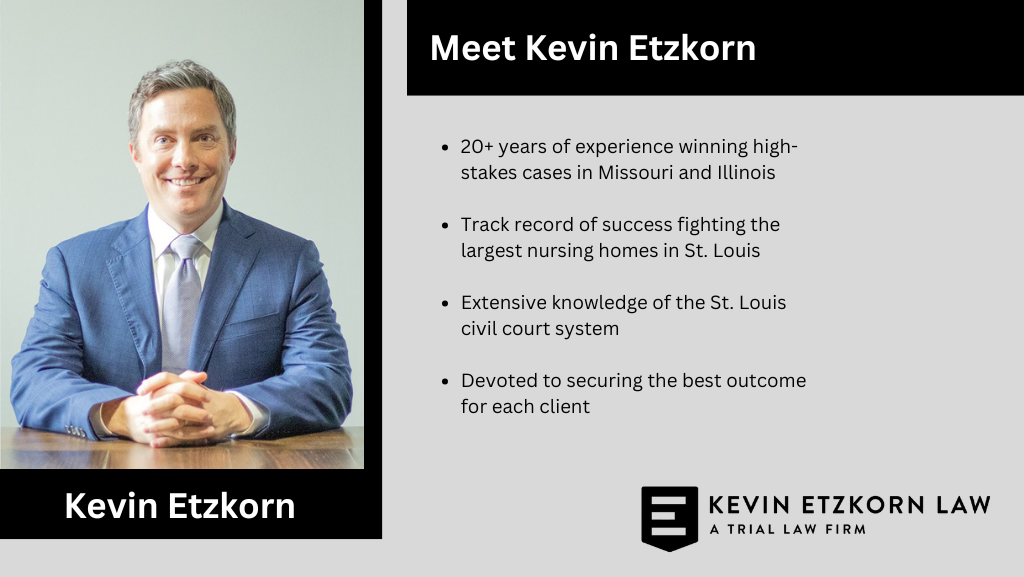
Bedsore and pressure ulcer cases are institutional negligence cases at their core. They require careful record review, wound care expertise, and a willingness to take on well funded corporate defendants. Kevin Etzkorn Law is intentionally selective, taking on a limited number of serious matters at a time so each family receives direct attorney attention and thorough case preparation. Kevin is a St. Louis native with more than twenty years of Missouri trial experience, a Super Lawyers selectee, and has been recognized among Top 100 High Stakes Litigators. You can read more about the firm’s approach on the Kevin Etzkorn Law about page.
We accept these cases on a contingency fee basis, which means there is no charge to talk with us, no charge to investigate, and no fee unless we obtain a recovery for your family.

Frequently Asked Questions
Is a bedsore always the result of nursing home negligence?
No, not always, but Stage III and Stage IV pressure ulcers that develop or worsen under a facility’s care almost always indicate substandard care. Reviewing the full medical chart, care plans, and repositioning logs is the best way to determine whether the injury was preventable in a specific case.
How long do I have to file a bedsore lawsuit in Missouri?
The deadline depends on the theory of the case, with Missouri’s general personal injury statute of limitations at five years, medical negligence at two years, and wrongful death at three years from the date of death. Because evidence disappears quickly and because different deadlines may apply, families should not wait to consult a St. Louis pressure ulcer lawyer.
What if the facility says my loved one’s bedsore was unavoidable?
Facilities frequently claim serious pressure injuries were unavoidable, but federal and clinical standards recognize very few situations where a Stage III or Stage IV wound is truly unavoidable. Independent review of the chart by a qualified wound care expert is typically the best way to test that claim.
Do I need to move my loved one out of the facility before calling a lawyer?
No. You can call a St. Louis bedsore lawyer at any time without changing your loved one’s placement, and doing so does not automatically trigger any action by the facility. We help families think through options, but the choice of where a loved one receives care always stays with the family.
Talk to a St. Louis Bedsore and Pressure Ulcer Lawyer Today
Serious pressure injuries are a warning sign that a facility is failing the people in its care. If your loved one has developed a Stage III, Stage IV, unstageable, or deep tissue injury under the care of a St. Louis area nursing home, hospital, or assisted living facility, you have the right to demand answers and to hold that facility accountable. Call Kevin Etzkorn Law at (314) 987-0009 or contact our St. Louis office to schedule a free, confidential consultation with a St. Louis pressure ulcer lawyer. Our office is located at 231 S. Bemiston Ave, Suite 250 in Clayton, and we represent residents and their families throughout the City of St. Louis, St. Louis County, St. Charles, Jefferson County, and the surrounding region. It costs nothing to call, and we only get paid if we win.
Get In Touch
What Our Clients Say
"Kevin Etzkorn is an outstanding personal injury attorney with great knowledge of the law."
"Kevin Etzkorn is a highly knowledgeable personal injury attorney that delivers terrific representation. I would happily recommend him and this firm to anyone."
"Kevin is an excellent attorney. Kevin has a unique ability to balance aggressive representation of the client, while always keeping his focus on what is in the best interest of the client."