
st. louis Nursing Home Fall Lawyer
Strategic Representation for Serious Nursing Home Fall Cases in St. Louis
A fall in a nursing home is rarely a minor event. For an elderly resident with fragile bones, thinning skin, and existing medical conditions, a single fall can mean a broken hip, a subdural hematoma, a traumatic brain injury, or the beginning of a decline that ends in death. Federal regulators and clinical experts have known for decades how to identify residents at risk and how to prevent most falls, and any facility that accepts a vulnerable resident is expected to do exactly that. When a nursing home resident suffers a serious fall, the critical question is whether the facility recognized the resident’s known fall risks and took reasonable steps to prevent the injury.
If your loved one suffered a fall in a St. Louis area nursing home, assisted living community, or long term care facility, you have the right to demand answers and to hold the facility accountable. Call Kevin Etzkorn Law at (314) 987-0009 today for a free, confidential consultation, or contact our St. Louis office online. As a St. Louis nursing home fall lawyer, Kevin Etzkorn has spent more than two decades handling institutional negligence cases in Missouri courts, and there is no fee unless we recover for your family.
Why Falls Happen in St. Louis Nursing Homes
Nursing home residents fall for predictable reasons. Age related muscle weakness, poor balance, cognitive impairment, low blood pressure, and side effects from common medications all raise the baseline fall risk of most residents. That is precisely why federal law requires facilities to identify each resident’s specific fall risks and put an individualized plan in place. When those steps are skipped or shortcut, falls happen, and they happen at rates far higher than clinical guidelines would predict.
Common Root Causes of Preventable Falls
In the fall cases we handle, the underlying failures tend to fall into the same handful of categories:
- Inadequate fall risk assessment. Staff never completed or updated a formal fall risk tool such as the Morse Fall Scale, so no plan was ever built.
- Chronic understaffing. There were too few aides on the unit to answer call lights, help residents to the bathroom, or supervise wandering.
- Failure to implement fall precautions. The chart identified a resident as high risk, but the interventions on paper (bed alarms, low bed, fall mats, hip protectors, closer monitoring) were never actually in place.
- Delayed toileting response. Residents who cannot reach a call light or wait forty five minutes for help will try to get to the bathroom on their own.
- Medication side effects. Antipsychotics, benzodiazepines, sleep aids, and blood pressure medications can cause dizziness, sedation, and orthostatic hypotension, and staff often fail to reassess fall risk after new prescriptions.
- Environmental hazards. Wet floors, cluttered rooms, poor lighting, missing handrails, and improperly maintained wheelchairs and walkers contribute to falls.
- Improper transfers. Aides moving residents between bed and chair without proper technique, proper equipment, or a second staff member frequently drop them.
- Failure to communicate risk between shifts. A resident who fell on day shift, or who was showing new confusion, is not always flagged to the incoming staff.
None of these are complex medical failures. They are basic operational failures that Missouri long term care facilities are supposed to prevent. For a broader view of how we frame institutional negligence cases, review our St. Louis nursing home lawyer page.
Common Injuries From Nursing Home Falls
Elderly residents rarely walk away from falls without significant injury. The Centers for Disease Control and Prevention reports that falls are the leading cause of injury and injury death among adults over sixty five, and the risk climbs sharply in institutional settings. The injuries we see most frequently in St. Louis nursing home fall cases include:
Nursing Home Hip Fractures and Broken Hips
A nursing home hip fracture is one of the most common and most consequential fall injuries we see in St. Louis cases. Recovery from a nursing home broken hip typically requires surgery, prolonged rehabilitation, and permanent loss of independence. A significant percentage of elderly hip fracture patients never return to their prior level of function, and mortality within a year of a broken hip is substantial. Families who first hear the phrase “your mother has a broken hip” from a facility nurse often had no idea their loved one was ever at risk.
Nursing Home Head Injuries and Subdural Hematomas
A nursing home head injury can happen with a fall from a bed, wheelchair, or standing position, and often occurs without any obvious external wound. Subdural hematomas are particularly dangerous in elderly residents because symptoms can develop gradually over hours or days, and residents on blood thinners face heightened risk. Staff who dismiss a fall as minor and fail to escalate a suspected head injury to imaging can miss a life threatening bleed.
Spinal Injuries
Falls can cause vertebral compression fractures, cervical fractures, and spinal cord injuries, all of which can permanently change a resident’s mobility and quality of life.
Wrist, Shoulder, and Rib Fractures
Instinctive attempts to break a fall commonly cause wrist and shoulder fractures. Landings on the side cause rib fractures, which in elderly residents can lead to pneumonia and other pulmonary complications.
Nursing Home Fall Wrongful Death
Falls are a leading cause of preventable death in nursing homes, and a nursing home fall wrongful death claim is often the appropriate remedy when the injury proves fatal. When a fall causes a fatal injury or triggers a cascade of complications that ends in death, families may pursue a wrongful death claim under Missouri law.
The Standard of Care for Fall Prevention
Facilities are not required to prevent every fall. They are required to identify residents at risk, plan for that risk, and implement reasonable interventions. Any competent facility should:
- Perform a fall risk assessment on admission and at regular intervals thereafter
- Reassess after any change in condition, new medication, or prior fall
- Build an individualized care plan that identifies the specific interventions the resident needs
- Actually implement the interventions listed in the care plan
- Toilet residents on a schedule and answer call lights promptly
- Review medications regularly for fall risk contributions
- Maintain safe environments including clean, dry, well lit floors and functional call systems
- Use proper transfer technique and appropriate equipment such as gait belts and mechanical lifts
- Document each fall and the resulting care plan revisions
Federal regulators enforce these expectations through survey findings, most notably CMS F-tag 689 covering accidents and supervision. Repeated citations under F-689 are a strong indicator of a facility with systemic problems. The Medicare Care Compare tool publishes those findings for every Medicare and Medicaid certified nursing facility.
Missouri Law and Nursing Home Fall Claims
Missouri residents and their families have both statutory and common law protections when a facility fails to prevent a serious fall.
Federal and Missouri Resident Rights
Nursing home residents are protected by the federal Nursing Home Reform Act and by Missouri’s Omnibus Nursing Home Act, Chapter 198 of the Missouri Revised Statutes. Both establish minimum standards of care and require facilities to provide the supervision and assistance needed to prevent accidents. Missouri’s Department of Health and Senior Services enforces state licensing standards and investigates complaints against long term care providers.
Statute of Limitations
The Missouri deadline for filing a nursing home fall claim depends on the specific theory. The general personal injury statute of limitations is five years, medical negligence claims must be filed within two years, and a wrongful death claim from a fatal fall has a three year deadline from the date of death. Because evidence starts disappearing immediately after a fall, and because different deadlines can apply, families should not wait to consult a St. Louis nursing home fall lawyer.
Potentially Liable Parties
Responsibility often extends beyond the individual caregiver on duty. Potential defendants include the facility itself, the corporate parent or management company that sets staffing and training policies, individual administrators and directors of nursing, and in some cases equipment manufacturers or maintenance contractors. Identifying every responsible party matters because damages from a serious nursing home fall often exceed a single insurance policy. For a broader look at how the firm approaches complex injury cases, see our St. Louis personal injury lawyer page.
Evidence That Wins St. Louis Nursing Home Fall Cases
Fall cases live and die on the strength of the operational and clinical documentation. The records we routinely gather include the complete facility chart, admission and quarterly fall risk assessments, individualized care plans, physician and nursing orders, medication administration records, incident and accident reports, nursing notes surrounding the fall, staffing rosters for the relevant shift, call light response data where available, environmental logs, and any prior incident reports involving the same resident. We also pull state inspection findings and any prior CMS citations under F-689 or related tags, and we work with geriatricians, nursing experts, and life care planners to evaluate the standard of care and the true cost of the harm.
Two evidence patterns tend to be decisive: a resident who was formally identified as high risk but whose care plan interventions were never implemented, and a facility with a documented pattern of falls, complaints, or inspection findings that management chose not to address. Both are hallmarks of the kind of institutional negligence that fits the cases Kevin Etzkorn Law is built to handle. Fall cases often overlap with our St. Louis bedsore and pressure ulcer practice, because the same operational failures, particularly understaffing, tend to produce both kinds of injuries in the same residents.
Why We Look Beyond the Initial Chart
In one nursing home case handled by our firm, the medical record initially characterized a resident’s fall as unwitnessed. During litigation, additional evidence revealed that the person who authored the note had actually been present when the resident fell. Discrepancies like these are why we do not evaluate a nursing home fall based solely on the facility’s initial charting. Careful review of staffing schedules, deposition testimony, and cross referencing between records regularly surfaces information that changes the entire picture of a case.
Damages Recoverable in a Missouri Nursing Home Fall Case
Missouri law allows recovery for the full harm caused by a preventable fall. That includes past and future medical expenses for surgery, hospitalization, rehabilitation, imaging, and home health care; lost independence and the increased cost of a higher level of care going forward; pain and suffering, mental anguish, loss of dignity, and loss of normal life; wrongful death damages when the fall causes or accelerates the resident’s death; and aggravating circumstances damages in cases involving falsified records, repeat citations, or corporate decisions to cut staffing at the expense of resident safety.

Why Choose Kevin Etzkorn Law
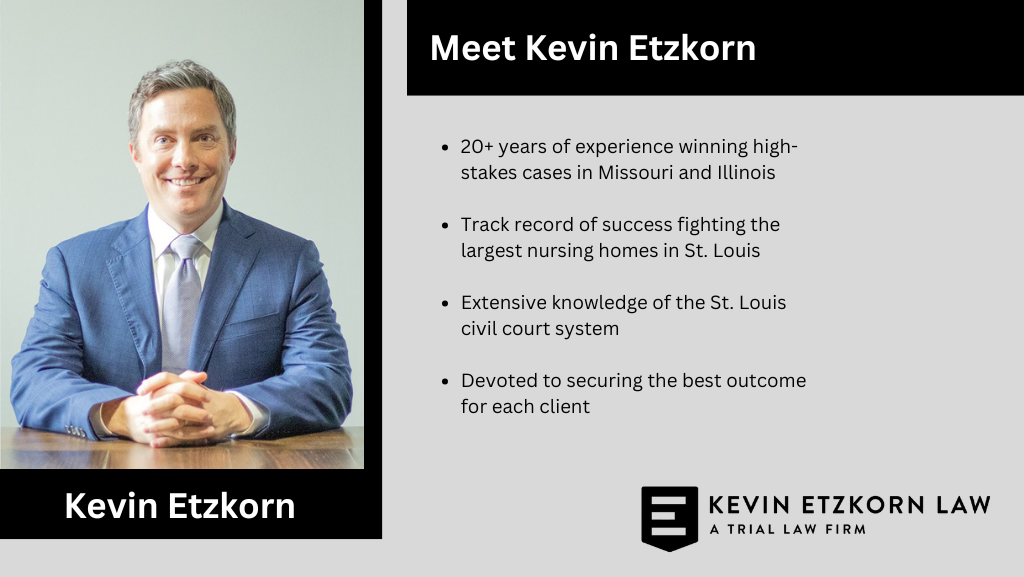
Nursing home fall cases require careful record review, clinical understanding of fall prevention standards, and a willingness to hold well funded corporate operators accountable. Kevin Etzkorn Law is intentionally selective, taking on a limited number of serious institutional negligence matters at a time so each family receives direct attorney attention and thorough case preparation. Kevin is a St. Louis native with more than twenty years of Missouri trial experience, a Super Lawyers selectee, and has been recognized among Top 100 High Stakes Litigators. You can read more about the firm’s philosophy on the Kevin Etzkorn Law about page.
We accept these cases on a contingency fee basis. There is no charge to talk with us, no charge to investigate, and no fee unless we obtain a recovery for your family.
Frequently Asked Questions
Is every nursing home fall the result of negligence?
No. Some falls happen even when a facility does everything right, particularly when residents have severe cognitive impairment or refuse recommended interventions. That said, when a serious fall injures a resident who was flagged as high risk but whose fall precautions were never implemented, or when a facility has a pattern of falls tied to understaffing, negligence is very likely the cause.
How long do I have to file a nursing home fall lawsuit in Missouri?
The deadline depends on the theory, with the general personal injury statute of limitations at five years, medical negligence at two years, and wrongful death at three years from the date of death. Because evidence disappears quickly and because different deadlines can apply, families should consult a St. Louis nursing home fall lawyer as soon as possible.
What if the facility says my loved one just tripped or “found themselves on the floor”?
Facilities frequently minimize serious falls with vague chart language such as “found on the floor” or “unwitnessed fall.” Those descriptions do not resolve the question of negligence, and a careful review of the fall risk assessment, care plan, staffing records, and physical layout of the room typically reveals whether the fall was preventable.
Should I file a complaint with the state before hiring a lawyer?
You can file a complaint with the Missouri Department of Health and Senior Services at any time, and doing so triggers a state investigation that can produce useful findings for a civil case. That said, the deadlines and evidence preservation issues in a civil case are independent of any state investigation, so consulting a lawyer promptly is still important.
Talk to a St. Louis Nursing Home Fall Lawyer Today
A serious fall is often the first visible sign that a nursing home is not delivering the care its residents were promised. If your loved one suffered a hip fracture, a head injury, a spinal injury, or died as a result of a fall in a St. Louis area facility, you have the right to demand answers and to hold the facility accountable. Call Kevin Etzkorn Law at (314) 987-0009 or contact our St. Louis office to schedule a free, confidential consultation with a St. Louis nursing home fall lawyer. Our office is located at 231 S. Bemiston Ave, Suite 250 in Clayton, and we represent residents and their families throughout the City of St. Louis, St. Louis County, St. Charles, Jefferson County, and the surrounding region. It costs nothing to call, and we only get paid if we win.
Get In Touch
What Our Clients Say
"Kevin Etzkorn is an outstanding personal injury attorney with great knowledge of the law."
"Kevin Etzkorn is a highly knowledgeable personal injury attorney that delivers terrific representation. I would happily recommend him and this firm to anyone."
"Kevin is an excellent attorney. Kevin has a unique ability to balance aggressive representation of the client, while always keeping his focus on what is in the best interest of the client."