
st. louis Medical Malpractice Lawyer
Skilled St. Louis Medical Malpractice Lawyer Holding Providers Accountable
When you walk into a hospital, surgical center, or doctor’s office, you trust that the people caring for you will meet the basic standard of care. Most of the time they do. But when a provider misses a diagnosis, performs a procedure incorrectly, ignores warning signs, or fails to communicate critical information, the consequences can be life altering or fatal. Sepsis goes untreated. A stroke goes unrecognized. A surgical instrument is left inside the body. A child suffers a preventable birth injury. The harm falls on the patient and their family, not on the provider whose error caused it.
Holding hospitals and physicians accountable in Missouri is not easy. The defense bar is well funded, the discovery process is technical, and Missouri’s rules require expert support before a case can even be filed. You need a trial lawyer who has handled these cases before. Call Kevin Etzkorn Law at (314) 987-0009 today for a free, confidential consultation, or contact our St. Louis office. Kevin Etzkorn has been pursuing medical negligence cases in Missouri for more than two decades, and there is no fee unless we win.
What Counts as Medical Malpractice in Missouri?
Medical malpractice is professional negligence by a healthcare provider that causes injury to a patient. To prove a claim, an injured patient must establish four things: that the provider owed a duty of care, that the provider breached the applicable standard of care, that the breach caused the injury, and that the patient suffered actual damages as a result. Missouri’s medical malpractice framework is set out in Missouri Revised Statutes Chapter 538, which also imposes specific procedural requirements and damage caps.
The Affidavit of Merit Requirement
Missouri requires plaintiffs in medical malpractice cases to file an affidavit of merit from a qualified healthcare provider stating that the defendant failed to meet the standard of care and that the failure caused the injury. The affidavit must be filed within ninety days of the lawsuit being filed. This requirement keeps frivolous cases out of the system but also raises the upfront cost and effort of bringing a legitimate claim. We work with experienced medical experts to support every case we take.
Standard of Care in Missouri
The standard of care is what a reasonably prudent provider in the same specialty would have done under the same circumstances. It is established through expert testimony and varies by specialty, location, and clinical scenario. Showing exactly how the provider deviated from that standard is the heart of every malpractice case.
Common Types of Medical Malpractice Cases We Handle in St. Louis
St. Louis is a major medical hub, with large hospital systems including BJC HealthCare, SSM Health, Mercy, and St. Luke’s. Where there are large volumes of care being delivered, there are also significant volumes of preventable error. The cases we see most often include:
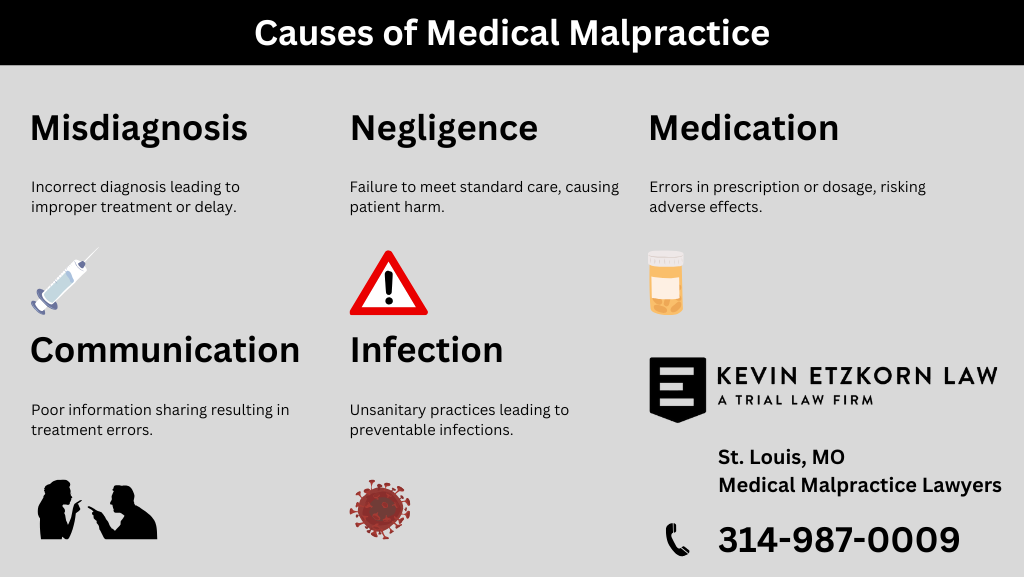
Misdiagnosis and Delayed Diagnosis
Missed or delayed diagnosis of cancer, stroke, heart attack, sepsis, pulmonary embolism, and meningitis are among the most common malpractice patterns. According to a 2023 BMJ Quality and Safety study, diagnostic errors contribute to hundreds of thousands of permanent disabilities and deaths in the United States each year.
Surgical Errors
Surgical errors range from wrong site surgery and retained foreign objects to nerve injuries, anesthesia errors, and post operative infections caused by poor technique or inadequate follow up.
Birth Injuries
Birth injuries such as cerebral palsy, hypoxic ischemic encephalopathy, brachial plexus injuries, and uterine rupture often involve a failure to monitor fetal heart tones, a delay in performing a cesarean section, or improper use of forceps or vacuum extraction.
Hospital Acquired Infections and Sepsis
Hospitals are required to follow strict infection control protocols. When they do not, patients can develop infections that progress to sepsis. Failure to recognize and treat sepsis quickly is a recurring pattern in our cases.
Medication and Prescription Errors
Wrong medications, wrong dosages, dangerous interactions, and pharmacy fill errors all fall within our practice. We handle these cases as part of our St. Louis prescription error practice, which focuses specifically on pharmacy and medication based negligence.
Emergency Room Errors
Emergency rooms operate under pressure, but pressure does not excuse missed diagnoses, premature discharge, or failure to order obvious imaging. ER cases require careful review of triage records, vital signs, and clinical decision making.
Nursing and Long Term Care Negligence
Negligence by nursing staff in hospitals or long term care facilities can lead to falls, pressure ulcers, dehydration, and medication errors. When the harm occurs in a nursing home, we handle the matter through our St. Louis nursing home practice.
How Missouri’s Medical Malpractice Laws Affect Your Case
Missouri has imposed specific rules and caps on medical malpractice claims that every patient should understand before proceeding.
Statute of Limitations
The general statute of limitations for medical malpractice in Missouri is two years from the date of the negligent act, far shorter than the five year window for ordinary personal injury. Limited exceptions exist for foreign objects left in the body and for minors, but the basic rule is strict and missing it is fatal to the claim. If you suspect malpractice, contact a lawyer right away.
Damage Caps
Missouri caps non-economic damages in medical malpractice cases. The cap is adjusted annually for inflation and is higher in catastrophic injury and wrongful death cases. There is no cap on economic damages such as medical expenses and lost wages. Caps can have a significant impact on case strategy, particularly in matters where pain and suffering damages would otherwise be substantial.
Pretrial Notice and Mediation
Missouri also requires pretrial procedures including affidavits of merit and, in some cases, mediation before trial. Knowing the procedural landscape is part of why hiring a lawyer who actually handles these cases matters. To learn more about the firm’s approach to high stakes injury matters, visit our St. Louis personal injury page.

Hospitals in St. Louis
- One Barnes Jewish Hospital Plaza, St. Louis, MO 63110
- (314) 747-3000
- One Children’s Pl, St. Louis, MO 63110
- (314) 454-6000
SSM Health Saint Louis University Hospital
- 1201 S Grand Blvd, St. Louis, MO 63104
- (314) 257-8000
- 615 S New Ballas Rd, St. Louis, MO 63141
- (314) 251-6000
- 232 S Woods Mill Rd, Chesterfield, MO 63017
- (314) 434-1500
Missouri Baptist Medical Center
- 3015 N Ballas Rd, St. Louis, MO 63131
- (314) 996-5000
How to Tell If You Have a Medical Malpractice Case
Bad outcomes happen even when providers do everything right. Not every adverse result is malpractice. The question is whether the provider’s care fell below the standard a competent professional would have provided in the same circumstances and whether that failure caused harm. Common warning signs include:
- A condition was missed despite obvious symptoms or test results
- A test or imaging study should have been ordered and was not
- A diagnosis was given but treatment did not follow timely
- A surgical complication does not match what you were warned about
- Vital signs or warning signs in the record were ignored
- Medication doses appear to have been incorrect
- A loved one’s condition deteriorated rapidly without intervention
- The provider or hospital is reluctant to provide records
If any of these apply, a free consultation costs nothing and helps you understand whether further investigation is warranted. The American Medical Association and other professional organizations publish guidelines that often inform our case theories.
Damages Available in a St. Louis Medical Malpractice Case
When we prove that a provider’s negligence caused harm, Missouri law allows recovery of:
Economic Damages
Economic damages cover quantifiable financial losses including past and future medical expenses, lost wages, lost earning capacity, in home care costs, durable medical equipment, home modifications, and other out of pocket expenses. There is no cap on economic damages.
Non-Economic Damages
Non-economic damages cover pain and suffering, mental anguish, disfigurement, loss of normal life, and loss of consortium. These damages are subject to Missouri’s statutory cap.
Wrongful Death Damages
When malpractice causes the death of a patient, the family may bring a wrongful death claim under Missouri’s wrongful death statute. Damages include the loss of the deceased’s income, services, support, and companionship, plus aggravating circumstances damages where appropriate.
Why Choose Kevin Etzkorn Law for Your Medical Malpractice Case
Medical malpractice is a specialized field. The defense firms representing hospitals and physicians are well resourced and well prepared. You need a lawyer who has done this work before, knows how to retain the right experts, knows how to read a medical chart, and is willing to take a case to verdict when needed.
Kevin Etzkorn has more than twenty years of experience in Missouri civil litigation, including significant medical negligence work. He is a Super Lawyers selectee, has been recognized among Top 100 High Stakes Litigators, and has obtained multi-million dollar results for clients. You can learn more about Kevin’s background and trial philosophy on the firm’s about page.
We work on contingency. There is no fee to talk with us. No fee to investigate. No fee unless we win.
Frequently Asked Questions
How long do I have to file a medical malpractice lawsuit in Missouri?
Missouri’s general medical malpractice statute of limitations is two years from the date of the negligent act, with limited exceptions for foreign objects left in the body and for minors. Because investigation and expert review take time, you should consult an attorney as soon as you suspect malpractice rather than waiting until the deadline approaches.
Do I really need a medical expert to file a malpractice case?
Yes. Missouri requires plaintiffs in medical negligence cases to file an affidavit of merit from a qualified healthcare provider within ninety days of filing suit, and you cannot prove the standard of care or causation at trial without expert testimony. We work with respected medical experts to support every case we accept.
How much is a Missouri medical malpractice case worth?
Value depends on the severity of the harm, the strength of the evidence, the impact on your life, and the available insurance coverage, with Missouri’s non-economic damage cap acting as one ceiling on certain categories of damages. After reviewing your records, we can give you a realistic assessment.
Will I have to go to trial if I hire your firm?
Most medical malpractice cases settle without a full trial, but settlement values are highest when the defense knows you are prepared to try the case. We prepare every case as if it will go to a jury, and Kevin Etzkorn has the trial experience to back that up.
Speak With a St. Louis Medical Malpractice Lawyer Today
If you or someone you love was seriously harmed because a hospital, doctor, nurse, or other provider failed to deliver the care they were supposed to deliver, you may have a valid medical malpractice claim. Call Kevin Etzkorn Law at (314) 987-0009 or contact our St. Louis office to schedule your free, confidential consultation. Our office is located at 231 S. Bemiston Ave, Suite 250 in Clayton, and we represent patients and families across the City of St. Louis, St. Louis County, St. Charles, Jefferson County, and the surrounding region. It costs nothing to call, and we only get paid if we win.
Get In Touch
Recent Outcomes
Our goal is to provide exceptional legal representation and achieve justice for those who have suffered due to others’ negligence. Explore our case results to see the impact of our commitment and expertise. Here are a few recent outcomes:
- Confidential settlement against paramedics for failure to timely intubate a patient suffering respiratory distress.
- Confidential settlement with dentist for wrongful extraction of 2 permanent teeth.
- A medical malpractice case settled in the fourth week of a lengthy trial. The suit involved claims of paralysis due to a delayed diagnosis and treatment of a spinal infection. Kevin worked with another attorney representing a hospital. Kevin conducted years of discovery, deposed numerous liability experts and handled virtually every aspect of the case and assisted throughout trial with bringing the case to a favorable resolution.
- A physical therapist was sued for malpractice. Kevin and another lawyer defended the therapist and a hospital for several years. The case went to trial, where Kevin served a crucial role handling damage expert witnesses. The case ended in a defense verdict.

What Our Clients Say
"Kevin Etzkorn is an outstanding personal injury attorney with great knowledge of the law."
"Kevin Etzkorn is a highly knowledgeable personal injury attorney that delivers terrific representation. I would happily recommend him and this firm to anyone."
"Kevin is an excellent attorney. Kevin has a unique ability to balance aggressive representation of the client, while always keeping his focus on what is in the best interest of the client."